By Judith Ferdinand | Nature News – Mwanza
The Mwanza Youth and Children Network (MYCN) is empowering children to fight climate change through education, tree-planting, and climate resilience projects as part of behavior change.
Communities Still Overlook Children in Climate Discussions
According to the Mwanza Youth and Children Network (MYCN), many communities still underestimate the role of children in addressing climate change. Society often assumes that the crisis affects only adults leaving children invisible in both the dialogue and the solutions.
A 2023 report on Climate Change and Human Rights by the Legal and Human Rights Centre (LHRC) found that key human rights such as access to health, food, education, clean water, and a safe environment are most affected by climate change. It further revealed that women and children are the most vulnerable groups.
“Train ups a child in the way he should go, and when he is old, he will not depart from it.” Proverbs 22:6
“The way you raise a child is the way they will grow.” Swahili proverb
MYCN believes that building climate awareness in children is crucial to developing a future generation capable of protecting the planet.
Children as Catalysts for Climate Action
Bryton George, a child journalist from MYCN, says teaching children about climate change early helps build a culture of responsibility that can transform entire communities.
“When a child learns early, they don’t keep that knowledge to themselves they share it with others. This helps spread climate education faster.”
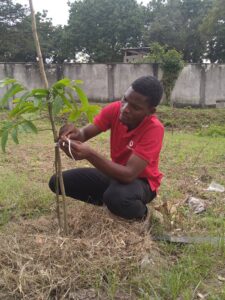
He explained that when children understand the impact of deforestation and the importance of planting trees, they grow up with lifelong habits that support environmental protection.
“For every tree cut, another must be planted. This becomes part of their lifestyle,” Bryton said.
He also suggested that birthdays could be used as moments to plant and care for trees—turning celebration into conservation.
Teaching Climate Resilience Early
Nuru Masanja, Project Officer for MYCN’s Child Climate Resilience Project in Mwanza, says children are central to lasting climate solutions.
“Adults often link climate issues to myths or traditions, but children are more adaptable. When they understand climate change, they influence their families and reshape community attitudes.”
Nuru emphasized that when children engage in activities like tree planting, waste separation, and cleanliness, these habits become part of their lives.
“It’s easier to shape a child’s behavior than to change an adult’s mindset,” she added.
She also pointed out that children are often directly affected by climate change without realizing it for instance, missing school days due to floods or heavy rains.
What MYCN Is Doing
Through the Child Climate Resilience Project funded by Sustainable Energy (Denmark) MYCN works in six wards in Ilemela and eleven wards in Nyamagana District. The main implementers are children themselves, including child journalists and members of children’s councils.
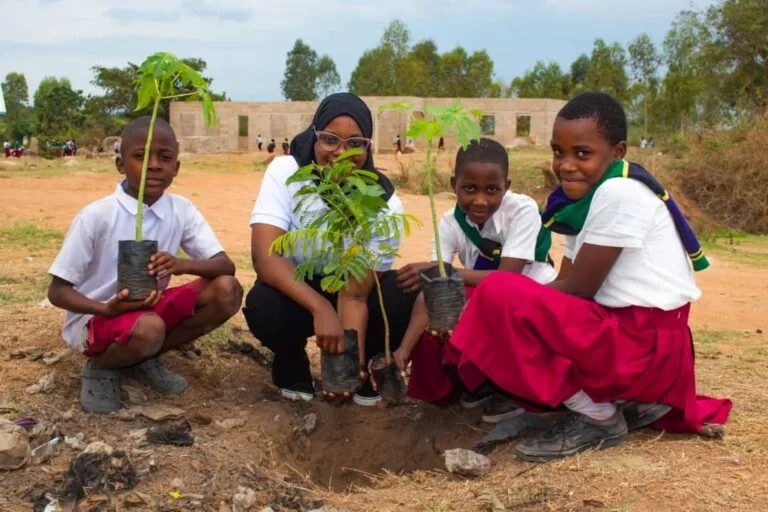
So far, the initiative has reached schools with climate debates, tree-planting campaigns, and awareness sessions. Over 500 tree seedlings have been distributed to five schools, where pupils are actively nurturing them.
“Children are powerful agents of change,” Nuru said.
“A child who learns early develops environmental stewardship that lasts for life.”
Schools Leading by Example
At Magaka Primary School in Ilemela Municipality, pupils have turned environmental care into daily practice. They plant trees, clean their surroundings, and restore eroded areas.
Angel Chacha, Assistant Secretary of the school’s Environment Club, said students are fully involved in caring for trees and the school environment. Fides Samuel, the club’s secretary, added that such involvement helps nurture a generation that sees environmental care as normal not as an obligation. Head teacher Mshongo Mmbaga praised the initiative:
“Our pupils are active participants in planting fruit and shade trees over 100 so far. Children are effective implementers. Assign each child to plant two or three trees in their family compound, and they’ll make a difference.”
Government and Community Support
Local authorities in Ilemela are also stepping up. Magembe Masalu, Adult Education Officer for Early and Primary Education, said involving children is crucial for long-term climate success.
“We’ve begun integrating children into environmental programs. Each year, we aim to plant over 10,000 trees in schools and public institutions,” Masalu said.
Mashelo Makila, the Municipal Primary Education Officer, suggested that policymakers adopt bylaws requiring every household to maintain at least three trees.
“If enforced, tree planting will move from being a rule to becoming part of daily life and culture,” he noted.
Environmental Officer David Mgunda emphasized that restoring natural vegetation is key to addressing climate change.
“We engage students in tree-planting campaigns and provide continuous environmental education,” he said.
In 2022/2023 alone, 39,700 trees were planted across schools, health centers, and communities. The following year, 40,727 trees were planted 80% in schools.
“Teachers should keep managing environment clubs and ensure pupils learn through hands-on practice. Environmental education must be practical,” Mgunda concluded